Complete classic literature • Five-line readings • Clear US narration
VELMORA ACADEMY
Academy of Archival Languages & Memory Studies
Menu Close
Les Misérables
Les Misérables

Chapter CCXIX

Chapter 219 of Les Misérables is here in full — 28 sentences across 6 reading sections, with audio for every sentence and word.

Chapter 219, section 1: Suddenly, the distant and melancholy vibration of a clock shook the panes. Six o’clock was striking from Saint-Médard. Jondrette marked off each stroke with a toss of his head. Whe
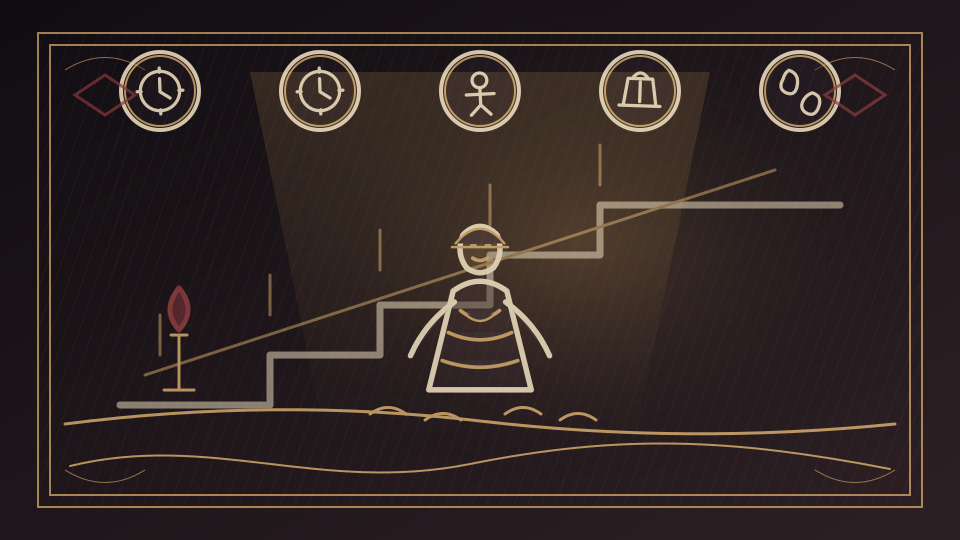
Context Illustration Reading 1/5 · 5 lines
English subtitles · tap any word to listen 1 / 5
Suddenly, the distant and melancholy vibration of a clock shook the panes.
Six o’clock was striking from Saint-Médard.
Jondrette marked off each stroke with a toss of his head.
When the sixth had struck, he snuffed the candle with his fingers.
Then he began to pace up and down the room, listened at the corridor, walked on again, then listened once more.
0:00 / 0:00
Speed 0.75x
AI-generated narration by OpenAI · Slow US English
LEARNER DICTIONARY
Archivist
/ˈɑːrkɪvɪst/
Editorial verification pending

A keeper or guardian of historical records and memories.

Les Misérables

Chapter CCXIX

Chapter 219 of Les Misérables is here in full — 28 sentences across 6 reading sections, with audio for every sentence and word.

Reading 1/5 · 5 reading units · Lines 1–5

Line 1
Suddenly, the distant and melancholy vibration of a clock shook the panes.
/ˈsʌdənli ðə ˈdɪstənt ənd ˈmelənkɑːli vaɪˈbreɪʃən ʌv ə klɑːk ʃʊk ðə peɪnz/
Line 2
Six o’clock was striking from Saint-Médard.
Line 3
Jondrette marked off each stroke with a toss of his head.
Line 4
When the sixth had struck, he snuffed the candle with his fingers.
/wen ðə sɪksθ hæd strʌk hiː snʌft ðə ˈkændəl wɪð hɪz ˈfɪŋɡərz/
Line 5
Then he began to pace up and down the room, listened at the corridor, walked on again, then listened once more.
/ðen hiː bɪˈɡæn tuː peɪs ʌp ənd daʊn ðə ruːm ˈlɪsənd æt ðə ˈkɔːrədər wɔːkt ɑːn əˈɡen ðen ˈlɪsənd wʌns mɔːr/

Learner Dictionary

These definitions explain words found in the current reading and keep every example grounded in its original sentence.

Oxford-style entry order: headword, part of speech, US IPA, concise definition, contextual example, and audio.

candle noun US /ˈkændəl/

stick of wax with a wick in the middle

From this reading “When the sixth had struck, he snuffed the candle with his fingers.”

corridor noun US /ˈkɔːrədər/

an enclosed passageway; rooms usually open onto it

From this reading “Then he began to pace up and down the room, listened at the corridor, walked on again, then listened once more.”

panes noun US /peɪnz/

plural of “pane” — sheet glass cut in shapes for windows or doors

From this reading “Suddenly, the distant and melancholy vibration of a clock shook the panes.”

sixth adjective US /sɪksθ/

coming next after the fifth and just before the seventh in position

From this reading “When the sixth had struck, he snuffed the candle with his fingers.”

snuffed verb US /snʌft/

past form of “snuff” — sniff or smell inquiringly

From this reading “When the sixth had struck, he snuffed the candle with his fingers.”

stroke noun US /stroʊk/

(sports) the act of swinging or striking at a ball with a club or racket or bat or cue or hand

From this reading “Jondrette marked off each stroke with a toss of his head.”

toss verb US /tɔːs/

throw or toss with a light motion

From this reading “Jondrette marked off each stroke with a toss of his head.”

vibration noun US /vaɪˈbreɪʃən/

the act of vibrating

From this reading “Suddenly, the distant and melancholy vibration of a clock shook the panes.”

Word partnerships in these lines

English keeps certain words together, and knowing the pair is worth more than knowing each word alone. Every partnership below was counted across our whole published library, and earns its place by appearing far more often than two unrelated words of the same frequency would.

Shown as this reading writes them, with the form the library counts, what kind of pairing it is, and how often it occurs.

once more adverb + adjective

anew

In this reading “Then he began to pace up and down the room, listened at the corridor, walked on again, then listened once more.”

All words in this reading · 49

Every word in these five lines is listed here, and every one of them can be played on its own.

Dictionary details are shown only when verified; these are not licensed Oxford entries.

adeterminerUS /ə/

used before a singular noun to mean one of a group, when it is not a particular one

From this reading Suddenly, the distant and melancholy vibration of a clock shook the panes.

againadverbUS /əˈɡen/

anew

From this reading Then he began to pace up and down the room, listened at the corridor, walked on again, then listened once more.

andconjunctionUS /ənd/

used to join words or parts of a sentence that go together

From this reading Suddenly, the distant and melancholy vibration of a clock shook the panes.

atprepositionUS /æt/

in or near a particular place or position

From this reading Then he began to pace up and down the room, listened at the corridor, walked on again, then listened once more.

beganverbUS /bɪˈɡæn/

inflected form of “begin” — take the first step or steps in carrying out an action

From this reading Then he began to pace up and down the room, listened at the corridor, walked on again, then listened once more.

candlenounUS /ˈkændəl/

stick of wax with a wick in the middle

From this reading When the sixth had struck, he snuffed the candle with his fingers.

clocknounUS /klɑːk/

a timepiece that shows the time of day

From this reading Suddenly, the distant and melancholy vibration of a clock shook the panes.

corridornounUS /ˈkɔːrədər/

an enclosed passageway; rooms usually open onto it

From this reading Then he began to pace up and down the room, listened at the corridor, walked on again, then listened once more.

distantadjectiveUS /ˈdɪstənt/

separated in space or coming from or going to a distance

From this reading Suddenly, the distant and melancholy vibration of a clock shook the panes.

downadjectiveUS /daʊn/

being or moving lower in position or less in some value

From this reading Then he began to pace up and down the room, listened at the corridor, walked on again, then listened once more.

eachdeterminerUS /iːtʃ/

every one of two or more people or things, taken separately

From this reading Jondrette marked off each stroke with a toss of his head.

fingersnounUS /ˈfɪŋɡərz/

plural of “finger” — any of the terminal members of the hand (sometimes excepting the thumb)

From this reading When the sixth had struck, he snuffed the candle with his fingers.

fromprepositionUS /frʌm/

showing where something starts, or who sent it

From this reading Six o’clock was striking from Saint-Médard.

hadauxiliary verbUS /hæd/

the past form of “have”, used to form the past perfect

From this reading When the sixth had struck, he snuffed the candle with his fingers.

hepronounUS /hiː/

a man, boy, or male animal already mentioned, as the subject

From this reading When the sixth had struck, he snuffed the candle with his fingers.

headnounUS /hed/

the upper part of the human body or the front part of the body in animals; contains the face and brains

From this reading Jondrette marked off each stroke with a toss of his head.

hisdeterminerUS /hɪz/

belonging to a man, boy, or male animal already mentioned

From this reading Jondrette marked off each stroke with a toss of his head.

Jondrette

Dictionary entry pending editorial verification. Tap Listen to hear the word.

From this reading Jondrette marked off each stroke with a toss of his head.

listenedverbUS /ˈlɪsənd/

past form of “listen” — hear with intention

From this reading Then he began to pace up and down the room, listened at the corridor, walked on again, then listened once more.

markedadjectiveUS /mɑːrkt/

strongly marked; easily noticeable

From this reading Jondrette marked off each stroke with a toss of his head.

melancholynounUS /ˈmelənkɑːli/

a feeling of thoughtful sadness

From this reading Suddenly, the distant and melancholy vibration of a clock shook the panes.

moreadjectiveUS /mɔːr/

(comparative of “much” used with mass nouns) a quantifier meaning greater in size or amount or extent or degree

From this reading Then he began to pace up and down the room, listened at the corridor, walked on again, then listened once more.

o'clockadverbUS /əˈklɑːk/

according to the clock

From this reading Six o’clock was striking from Saint-Médard.

ofprepositionUS /ʌv/

belonging to, or connected with, somebody or something

From this reading Suddenly, the distant and melancholy vibration of a clock shook the panes.

offadverbUS /ɔːf/

from a particular thing or place or position (“forth” is obsolete)

From this reading Jondrette marked off each stroke with a toss of his head.

onprepositionUS /ɑːn/

touching and supported by a surface

From this reading Then he began to pace up and down the room, listened at the corridor, walked on again, then listened once more.

onceadverbUS /wʌns/

on one occasion

From this reading Then he began to pace up and down the room, listened at the corridor, walked on again, then listened once more.

pacenounUS /peɪs/

the rate of moving (especially walking or running)

From this reading Then he began to pace up and down the room, listened at the corridor, walked on again, then listened once more.

panesnounUS /peɪnz/

plural of “pane” — sheet glass cut in shapes for windows or doors

From this reading Suddenly, the distant and melancholy vibration of a clock shook the panes.

roomnounUS /ruːm/

an area within a building enclosed by walls and floor and ceiling

From this reading Then he began to pace up and down the room, listened at the corridor, walked on again, then listened once more.

Saint-Médard

Dictionary entry pending editorial verification. Tap Listen to hear the word.

From this reading Six o’clock was striking from Saint-Médard.

shooknounUS /ʃʊk/

a disassembled barrel; the parts packed for storage or shipment

From this reading Suddenly, the distant and melancholy vibration of a clock shook the panes.

SixnounUS /sɪks/

the cardinal number that is the sum of five and one

From this reading Six o’clock was striking from Saint-Médard.

sixthadjectiveUS /sɪksθ/

coming next after the fifth and just before the seventh in position

From this reading When the sixth had struck, he snuffed the candle with his fingers.

snuffedverbUS /snʌft/

past form of “snuff” — sniff or smell inquiringly

From this reading When the sixth had struck, he snuffed the candle with his fingers.

strikingadjectiveUS /ˈstraɪkɪŋ/

sensational in appearance or thrilling in effect

From this reading Six o’clock was striking from Saint-Médard.

strokenounUS /stroʊk/

(sports) the act of swinging or striking at a ball with a club or racket or bat or cue or hand

From this reading Jondrette marked off each stroke with a toss of his head.

struckadjectiveUS /strʌk/

(used in combination) affected by something overwhelming

From this reading When the sixth had struck, he snuffed the candle with his fingers.

SuddenlyadverbUS /ˈsʌdənli/

happening unexpectedly

From this reading Suddenly, the distant and melancholy vibration of a clock shook the panes.

thedeterminerUS /ðə/

used before a noun that is already known, already mentioned, or the only one of its kind

From this reading Suddenly, the distant and melancholy vibration of a clock shook the panes.

ThenadverbUS /ðen/

subsequently or soon afterward (often used as sentence connectors)

From this reading Then he began to pace up and down the room, listened at the corridor, walked on again, then listened once more.

toparticleUS /tuː/

used before the base form of a verb to make the infinitive

From this reading Then he began to pace up and down the room, listened at the corridor, walked on again, then listened once more.

tossverbUS /tɔːs/

throw or toss with a light motion

From this reading Jondrette marked off each stroke with a toss of his head.

upadjectiveUS /ʌp/

being or moving higher in position or greater in some value; being above a former position or level

From this reading Then he began to pace up and down the room, listened at the corridor, walked on again, then listened once more.

vibrationnounUS /vaɪˈbreɪʃən/

the act of vibrating

From this reading Suddenly, the distant and melancholy vibration of a clock shook the panes.

walkedverbUS /wɔːkt/

past form of “walk” — use one's feet to advance; advance by steps

From this reading Then he began to pace up and down the room, listened at the corridor, walked on again, then listened once more.

wasauxiliary verbUS /wɑːz/

the past form of “be” used with I, he, she, it, or a singular noun

From this reading Six o’clock was striking from Saint-Médard.

WhenconjunctionUS /wen/

at the time that

From this reading When the sixth had struck, he snuffed the candle with his fingers.

withprepositionUS /wɪð/

in the company of; together with

From this reading Jondrette marked off each stroke with a toss of his head.

Chapter 219 of Les Misérables by Victor Hugo holds 28 sentences, grouped into 6 reading sections of at most 5 sentences. The text is the source edition, unabridged, and the chapter records which sentences cover which part of the work so that nothing is dropped. Every word can be tapped for its pronunciation and dictionary entry.

What does chapter 219 of Les Misérables contain?

Chapter 219 holds 28 sentences of Les Misérables, unabridged, divided into 6 reading sections.

This page carries chapter 219 of Les Misérables by Victor Hugo exactly as it stands in the source edition, without abridgement. It runs to 28 sentences, grouped into 6 sections of at most 5 sentences so that a reader can take the chapter in steady, finishable pieces. The chapter also stores a coverage record mapping every one of its sentences to a part of the work, which is how the edition demonstrates that no line was dropped.

How do I study chapter 219 of Les Misérables?

Work through the 6 sections in order, replaying any sentence and tapping unfamiliar words for their entries.

Each of the 6 sections in this chapter is short enough to read once, hear once, and then re-read with the vocabulary in view. Tapping a word plays it alone and opens its dictionary entry with IPA, part of speech and meaning, so the reader is never forced to guess a pronunciation from spelling. Working section by section keeps a long chapter from becoming an undifferentiated wall of text, which is the usual reason a reader abandons a work of this period.

Can chapter 219 be read aloud to me?

Yes — every sentence and every individual word in chapter 219 can be played aloud in United States English.

Audio covers the whole chapter: any sentence can be played, and any single word within it can be played on its own. The voice uses United States English. For a work of this period that matters, because spelling is an unreliable guide to pronunciation for vocabulary that has fallen out of daily use, and a learner who guesses wrong tends to keep the error. Hearing the word in its own sentence, and then alone, settles it.

Questions about reading Les Misérables

Common questions about reading Les Misérables by Victor Hugo on this page, its source edition and its audio.

Is this the complete text of Les Misérables?

Yes. All 0 sentences of Project Gutenberg eBook #? are kept, with a record of which sentences cover which part.

Which edition of Les Misérables is used?

Project Gutenberg eBook #?, unabridged. The Project Gutenberg header, footer and licence are removed.

How long does Les Misérables take to read?

About 5 minutes of reading across 0 sections of 5 sentences each, at an unhurried pace.

How to read Les Misérables section by section

How to work through Les Misérables section by section, using the audio and the tap-to-define vocabulary.

  1. Open a chapter

    Choose one of the 0 chapters of Les Misérables to begin.

  2. Read one section

    Each section holds 5 sentences; read it once through.

  3. Listen and tap

    Play the section aloud, then tap any unfamiliar word for its entry.

Vocabulary met early in Les Misérables

Words and structures a reader meets early in Les Misérables, each tappable for pronunciation and meaning.

Chapter 1
One of the 0 chapters of Les Misérables, divided into 5-sentence reading sections.
Chapter 2
One of the 0 chapters of Les Misérables, divided into 5-sentence reading sections.
Chapter 3
One of the 0 chapters of Les Misérables, divided into 5-sentence reading sections.