Complete classic literature • Five-line readings • Clear US narration
VELMORA ACADEMY
Academy of Archival Languages & Memory Studies
Menu Close
Private Letters of Edward Gibbon (1753-1794) Volume 1 (of 2)

Chapter XIII

Chapter 13 of Private Letters of Edward Gibbon (1753-1794) Volume 1 (of 2) is here in full — 392 sentences across 79 reading sections, with audio for every sentence and word.

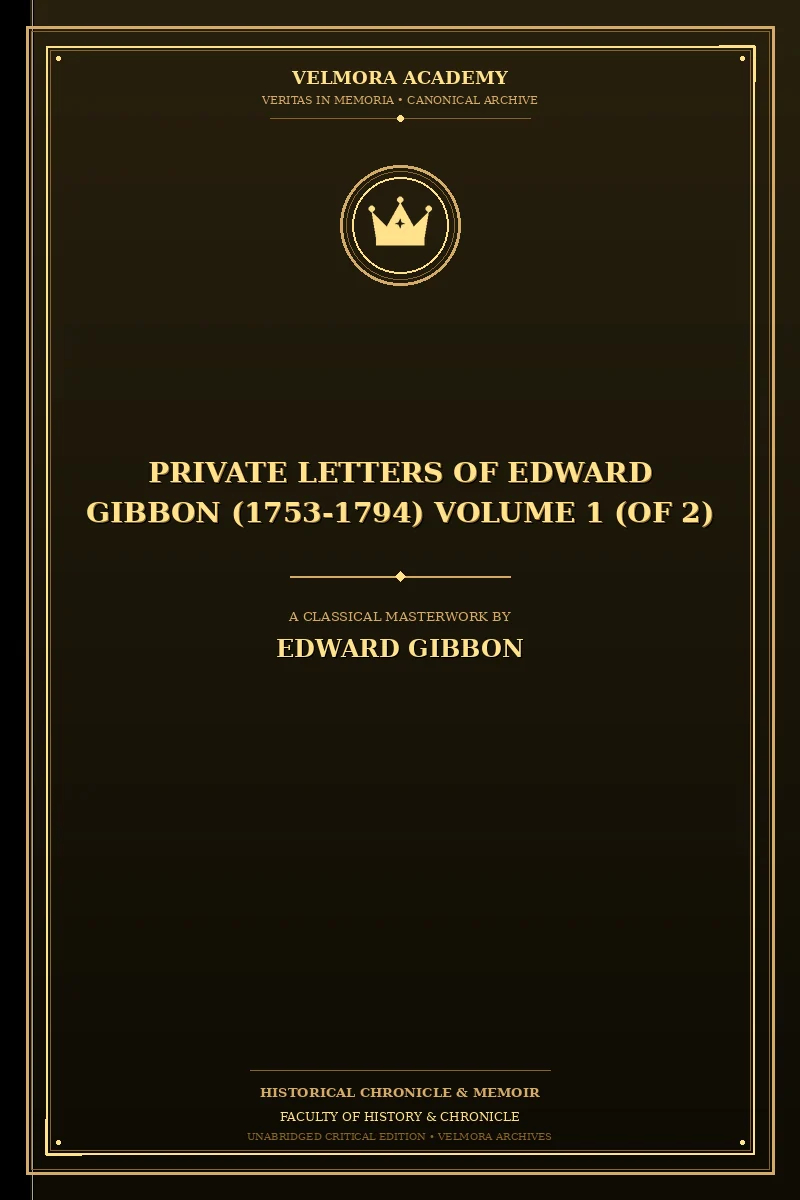
Cover illustration for Private Letters of Edward Gibbon (1753-1794) Volume 1 (of 2)
Context Illustration Reading 1/78 · 5 lines
English subtitles · tap any word to listen 1 / 5
E. G.
Sackville Street complained yesterday of silence.
[266] James Whitshed, M.P. for Cirencester.
230.
_To J. B. Holroyd, Esq._ December, 1774.
0:00 / 0:00
Speed 0.75x
AI-generated narration by OpenAI · Slow US English
LEARNER DICTIONARY
Archivist
/ˈɑːrkɪvɪst/
Editorial verification pending

A keeper or guardian of historical records and memories.

Private Letters of Edward Gibbon (1753-1794) Volume 1 (of 2)

Chapter XIII

Chapter 13 of Private Letters of Edward Gibbon (1753-1794) Volume 1 (of 2) is here in full — 392 sentences across 79 reading sections, with audio for every sentence and word.

Reading 1/78 · 5 reading units · Lines 1–5

Line 1
E. G.
/iː dʒiː/
Line 2
Sackville Street complained yesterday of silence.
Line 3
[266] James Whitshed, M.P. for Cirencester.
Line 4
230.
Line 5
_To J. B. Holroyd, Esq._ December, 1774.

Learner Dictionary

These definitions explain words found in the current reading and keep every example grounded in its original sentence.

Oxford-style entry order: headword, part of speech, US IPA, concise definition, contextual example, and audio.

complained verb US /kəmˈpleɪnd/

past form of “complain” — express complaints, discontent, displeasure, or unhappiness

From this reading “Sackville Street complained yesterday of silence.”

December noun US /dɪˈsembər/

the last (12th) month of the year

From this reading “_To J. B. Holroyd, Esq._ December, 1774.”

James noun US /dʒeɪmz/

a Stuart king of Scotland who married a daughter of Henry VII; when England and France went to war in 1513 he invaded England and died in defeat at Flodden (1473-1513)

From this reading “[266] James Whitshed, M.P. for Cirencester.”

silence noun US /ˈsaɪ.ləns/

Complete absence of sound; a state of quietness and stillness.

From this reading “Sackville Street complained yesterday of silence.”

Street noun US /striːt/

a thoroughfare (usually including sidewalks) that is lined with buildings

From this reading “Sackville Street complained yesterday of silence.”

yesterday noun US /ˈjestərdeɪ/

the day immediately before today

From this reading “Sackville Street complained yesterday of silence.”

All words in this reading · 23

Every word in these five lines is listed here, and every one of them can be played on its own.

Dictionary details are shown only when verified; these are not licensed Oxford entries.

1774

Dictionary entry pending editorial verification. Tap Listen to hear the word.

From this reading _To J. B. Holroyd, Esq._ December, 1774.

230

Dictionary entry pending editorial verification. Tap Listen to hear the word.

From this reading 230.

266

Dictionary entry pending editorial verification. Tap Listen to hear the word.

From this reading [266] James Whitshed, M.P. for Cirencester.

BnounUS /biː/

aerobic rod-shaped spore-producing bacterium; often occurring in chainlike formations; found primarily in soil

From this reading _To J. B. Holroyd, Esq._ December, 1774.

Cirencester

Dictionary entry pending editorial verification. Tap Listen to hear the word.

From this reading [266] James Whitshed, M.P. for Cirencester.

complainedverbUS /kəmˈpleɪnd/

past form of “complain” — express complaints, discontent, displeasure, or unhappiness

From this reading Sackville Street complained yesterday of silence.

DecembernounUS /dɪˈsembər/

the last (12th) month of the year

From this reading _To J. B. Holroyd, Esq._ December, 1774.

EnounUS /iː/

a fat-soluble vitamin that is essential for normal reproduction; an important antioxidant that neutralizes free radicals in the body

From this reading E. G.

Esqnoun

a title of respect for a member of the English gentry ranking just below a knight; placed after the name

From this reading _To J. B. Holroyd, Esq._ December, 1774.

forprepositionUS /fɔːr/

intended to be given to, or used by, somebody

From this reading [266] James Whitshed, M.P. for Cirencester.

GnounUS /dʒiː/

a metric unit of weight equal to one thousandth of a kilogram

From this reading E. G.

Holroyd

Dictionary entry pending editorial verification. Tap Listen to hear the word.

From this reading _To J. B. Holroyd, Esq._ December, 1774.

JnounUS /dʒeɪ/

a unit of electrical energy equal to the work done when a current of one ampere passes through a resistance of one ohm for one second

From this reading _To J. B. Holroyd, Esq._ December, 1774.

JamesnounUS /dʒeɪmz/

a Stuart king of Scotland who married a daughter of Henry VII; when England and France went to war in 1513 he invaded England and died in defeat at Flodden (1473-1513)

From this reading [266] James Whitshed, M.P. for Cirencester.

MnounUS /em/

the basic unit of length adopted under the Systeme International d'Unites (approximately 1.094 yards)

From this reading [266] James Whitshed, M.P. for Cirencester.

ofprepositionUS /ʌv/

belonging to, or connected with, somebody or something

From this reading Sackville Street complained yesterday of silence.

PnounUS /piː/

a multivalent nonmetallic element of the nitrogen family that occurs commonly in inorganic phosphate rocks and as organic phosphates in all living cells; is highly reactive and occurs in several allotropic forms

From this reading [266] James Whitshed, M.P. for Cirencester.

Sackville

Dictionary entry pending editorial verification. Tap Listen to hear the word.

From this reading Sackville Street complained yesterday of silence.

silencenounUS /ˈsaɪ.ləns/

Complete absence of sound; a state of quietness and stillness.

From this reading Sackville Street complained yesterday of silence.

StreetnounUS /striːt/

a thoroughfare (usually including sidewalks) that is lined with buildings

From this reading Sackville Street complained yesterday of silence.

ToparticleUS /tuː/

used before the base form of a verb to make the infinitive

From this reading _To J. B. Holroyd, Esq._ December, 1774.

Whitshed

Dictionary entry pending editorial verification. Tap Listen to hear the word.

From this reading [266] James Whitshed, M.P. for Cirencester.

yesterdaynounUS /ˈjestərdeɪ/

the day immediately before today

From this reading Sackville Street complained yesterday of silence.

Chapter 13 of Private Letters of Edward Gibbon (1753-1794) Volume 1 (of 2) by Edward Gibbon holds 392 sentences, grouped into 79 reading sections of at most 5 sentences. The text is the source edition, unabridged, and the chapter records which sentences cover which part of the work so that nothing is dropped. Every word can be tapped for its pronunciation and dictionary entry.

What does chapter 13 of Private Letters of Edward Gibbon (1753-1794) Volume 1 (of 2) contain?

Chapter 13 holds 392 sentences of Private Letters of Edward Gibbon (1753-1794) Volume 1 (of 2), unabridged, divided into 79 reading sections.

This page carries chapter 13 of Private Letters of Edward Gibbon (1753-1794) Volume 1 (of 2) by Edward Gibbon exactly as it stands in the source edition, without abridgement. It runs to 392 sentences, grouped into 79 sections of at most 5 sentences so that a reader can take the chapter in steady, finishable pieces. The chapter also stores a coverage record mapping every one of its sentences to a part of the work, which is how the edition demonstrates that no line was dropped.

How do I study chapter 13 of Private Letters of Edward Gibbon (1753-1794) Volume 1 (of 2)?

Work through the 79 sections in order, replaying any sentence and tapping unfamiliar words for their entries.

Each of the 79 sections in this chapter is short enough to read once, hear once, and then re-read with the vocabulary in view. Tapping a word plays it alone and opens its dictionary entry with IPA, part of speech and meaning, so the reader is never forced to guess a pronunciation from spelling. Working section by section keeps a long chapter from becoming an undifferentiated wall of text, which is the usual reason a reader abandons a work of this period.

Can chapter 13 be read aloud to me?

Yes — every sentence and every individual word in chapter 13 can be played aloud in United States English.

Audio covers the whole chapter: any sentence can be played, and any single word within it can be played on its own. The voice uses United States English. For a work of this period that matters, because spelling is an unreliable guide to pronunciation for vocabulary that has fallen out of daily use, and a learner who guesses wrong tends to keep the error. Hearing the word in its own sentence, and then alone, settles it.

Questions about reading Private Letters of Edward Gibbon (1753-1794) Volume 1 (of 2)

Common questions about reading Private Letters of Edward Gibbon (1753-1794) Volume 1 (of 2) by Edward Gibbon on this page, its source edition and its audio.

Is this the complete text of Private Letters of Edward Gibbon (1753-1794) Volume 1 (of 2)?

Yes. All 7879 sentences of Project Gutenberg eBook #42578 are kept, with a record of which sentences cover which part.

Which edition of Private Letters of Edward Gibbon (1753-1794) Volume 1 (of 2) is used?

Project Gutenberg eBook #42578, unabridged. The Project Gutenberg header, footer and licence are removed.

How long does Private Letters of Edward Gibbon (1753-1794) Volume 1 (of 2) take to read?

About 600 minutes of reading across 1576 sections of 5 sentences each, at an unhurried pace.

How to read Private Letters of Edward Gibbon (1753-1794) Volume 1 (of 2) section by section

How to work through Private Letters of Edward Gibbon (1753-1794) Volume 1 (of 2) section by section, using the audio and the tap-to-define vocabulary.

  1. Open a chapter

    Choose one of the 20 chapters of Private Letters of Edward Gibbon (1753-1794) Volume 1 (of 2) to begin.

  2. Read one section

    Each section holds 5 sentences; read it once through.

  3. Listen and tap

    Play the section aloud, then tap any unfamiliar word for its entry.

Vocabulary met early in Private Letters of Edward Gibbon (1753-1794) Volume 1 (of 2)

Words and structures a reader meets early in Private Letters of Edward Gibbon (1753-1794) Volume 1 (of 2), each tappable for pronunciation and meaning.

Introduction
A word that appears in the opening chapter of Private Letters of Edward Gibbon (1753-1794) Volume 1 (of 2); the reader can tap it to hear it and see its dictionary entry.
Sheffield
A word that appears in the opening chapter of Private Letters of Edward Gibbon (1753-1794) Volume 1 (of 2); the reader can tap it to hear it and see its dictionary entry.
Edited
A word that appears in the opening chapter of Private Letters of Edward Gibbon (1753-1794) Volume 1 (of 2); the reader can tap it to hear it and see its dictionary entry.
Rowland
A word that appears in the opening chapter of Private Letters of Edward Gibbon (1753-1794) Volume 1 (of 2); the reader can tap it to hear it and see its dictionary entry.