filled with fear or apprehension
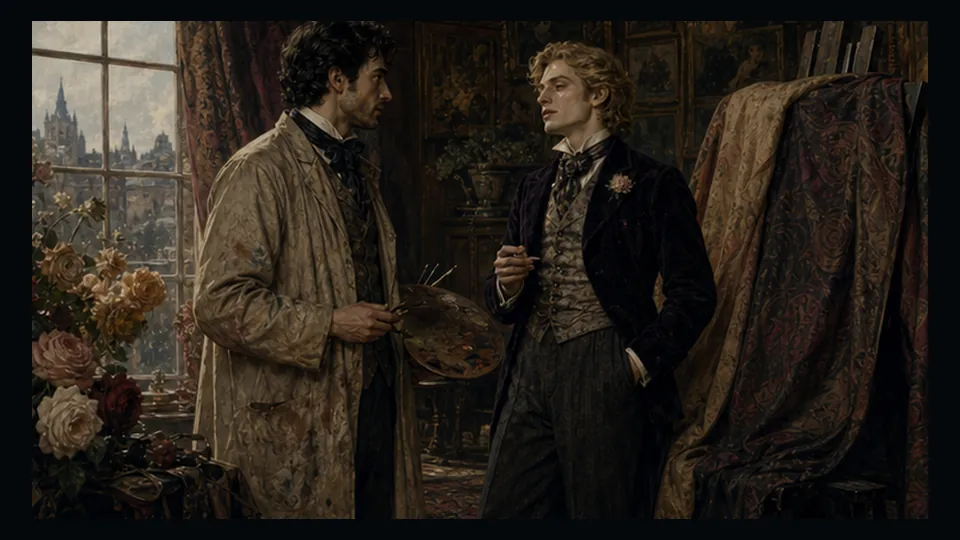
From this reading The reason I will not exhibit this picture is that I am afraid that I have shown in it the secret of my own soul.”
the form of “be” used with “I”
From this reading The reason I will not exhibit this picture is that I am afraid that I have shown in it the secret of my own soul.”
used to join words or parts of a sentence that go together
From this reading “And what is that?”
past form of “ask” — make a request or demand for something to somebody
From this reading he asked.
showing who or what does the action
From this reading It is not he who is revealed by the painter; it is rather the painter who, on the coloured canvas, reveals himself.
canvasnounUS /ˈkænvəs/
a heavy, closely woven fabric (used for clothing or chairs or sails or tents)
From this reading It is not he who is revealed by the painter; it is rather the painter who, on the coloured canvas, reveals himself.
colouredadjectiveUS /ˈkʌlərd/
having color or a certain color; sometimes used in combination
From this reading It is not he who is revealed by the painter; it is rather the painter who, on the coloured canvas, reveals himself.
exhibitverbUS /ɪɡˈzɪbɪt/
show an attribute, property, knowledge, or skill
From this reading The reason I will not exhibit this picture is that I am afraid that I have shown in it the secret of my own soul.”
haveauxiliary verbUS /hæv/
used with a past participle to form the perfect tenses
From this reading The reason I will not exhibit this picture is that I am afraid that I have shown in it the secret of my own soul.”
a man, boy, or male animal already mentioned, as the subject
From this reading It is not he who is revealed by the painter; it is rather the painter who, on the coloured canvas, reveals himself.
a unit of inductance in which an induced electromotive force of one volt is produced when the current is varied at the rate of one ampere per second
From this reading Lord Henry laughed.
used when the man or boy doing the action is also its object
From this reading It is not he who is revealed by the painter; it is rather the painter who, on the coloured canvas, reveals himself.
the person speaking or writing, as the subject of the verb
From this reading The reason I will not exhibit this picture is that I am afraid that I have shown in it the secret of my own soul.”
inside something, or within a place, period, or state
From this reading The reason I will not exhibit this picture is that I am afraid that I have shown in it the secret of my own soul.”
the form of “be” used with he, she, it, or a singular noun
From this reading It is not he who is revealed by the painter; it is rather the painter who, on the coloured canvas, reveals himself.
a thing, animal, or idea already mentioned
From this reading It is not he who is revealed by the painter; it is rather the painter who, on the coloured canvas, reveals himself.
past form of “laugh” — produce laughter
From this reading Lord Henry laughed.
terms referring to the Judeo-Christian God
From this reading Lord Henry laughed.
belonging to the person speaking
From this reading The reason I will not exhibit this picture is that I am afraid that I have shown in it the secret of my own soul.”
used to make a word, phrase, or sentence negative
From this reading It is not he who is revealed by the painter; it is rather the painter who, on the coloured canvas, reveals himself.
belonging to, or connected with, somebody or something
From this reading The reason I will not exhibit this picture is that I am afraid that I have shown in it the secret of my own soul.”
touching and supported by a surface
From this reading It is not he who is revealed by the painter; it is rather the painter who, on the coloured canvas, reveals himself.
have ownership or possession of
From this reading The reason I will not exhibit this picture is that I am afraid that I have shown in it the secret of my own soul.”
painternounUS /ˈpeɪntər/
an artist who paints
From this reading It is not he who is revealed by the painter; it is rather the painter who, on the coloured canvas, reveals himself.
a visual representation (of an object or scene or person or abstraction) produced on a surface
From this reading The reason I will not exhibit this picture is that I am afraid that I have shown in it the secret of my own soul.”
on the contrary
From this reading It is not he who is revealed by the painter; it is rather the painter who, on the coloured canvas, reveals himself.
a rational motive for a belief or action
From this reading The reason I will not exhibit this picture is that I am afraid that I have shown in it the secret of my own soul.”
past form of “reveal” — make visible
From this reading It is not he who is revealed by the painter; it is rather the painter who, on the coloured canvas, reveals himself.
revealsverbUS /rɪˈviːlz/
third-person singular of “reveal” — make visible
From this reading It is not he who is revealed by the painter; it is rather the painter who, on the coloured canvas, reveals himself.
Something that is kept or meant to be kept unknown or unseen by others.
From this reading The reason I will not exhibit this picture is that I am afraid that I have shown in it the secret of my own soul.”
inflected form of “show” — give an exhibition of to an interested audience
From this reading The reason I will not exhibit this picture is that I am afraid that I have shown in it the secret of my own soul.”
the immaterial part of a person; the actuating cause of an individual life
From this reading The reason I will not exhibit this picture is that I am afraid that I have shown in it the secret of my own soul.”
used to introduce what somebody said, thought, or felt
From this reading The reason I will not exhibit this picture is that I am afraid that I have shown in it the secret of my own soul.”
used before a noun that is already known, already mentioned, or the only one of its kind
From this reading It is not he who is revealed by the painter; it is rather the painter who, on the coloured canvas, reveals himself.
used for a person or thing that is near, or that has just been mentioned
From this reading The reason I will not exhibit this picture is that I am afraid that I have shown in it the secret of my own soul.”
used to ask for information about something
From this reading “And what is that?”
which person or people
From this reading It is not he who is revealed by the painter; it is rather the painter who, on the coloured canvas, reveals himself.
used to talk about the future, or about willingness
From this reading The reason I will not exhibit this picture is that I am afraid that I have shown in it the secret of my own soul.”